




As the cost of drafting approaches zero, the value of the idea itself reaches a premium. In an era where a high-quality professional article costs less than $100 to produce, we must ask: What is the value of an idea that cannot be generated by a model? The future belongs to those who use AI to build the floor of their content, but rely on human intuition to build the ceiling.
The Hook: A World Built by Algorithms and Authenticity
By late 2026, generative AI has transitioned from a disruptive novelty to a default utility. It is the plumbing of the digital world—essential, expected, and largely invisible. Yet, as the technical cost of content production has plummeted toward zero, a new economic paradox has emerged: the value of human trust has become the primary currency of the internet.
In an era where every brand and individual has access to the same high-powered LLMs, a critical divide has formed. Why are some creators and businesses seeing record-breaking engagement while others are systematically ignored by both users and algorithms? The answer lies in the “human-in-the-loop” imperative. The following insights are synthesized from the latest 2026 industry reports on AI adoption, the creator economy, and evolving ad mechanics, providing a roadmap for navigating this high-volume, high-stakes landscape.
1. The Small Business “AI Crossover” and the Enterprise Drag
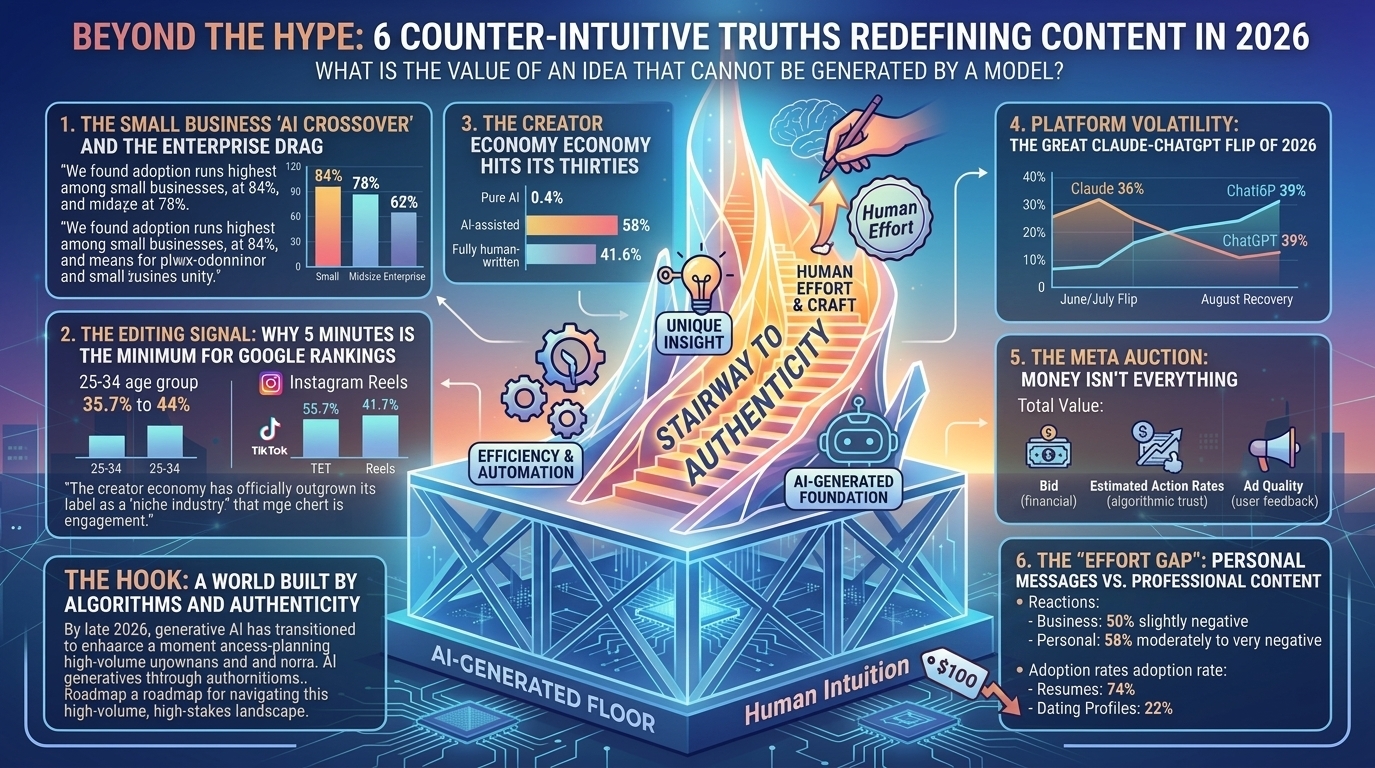
The year 2026 marks the completion of the “AI Crossover.” In 2023, midsize businesses led the charge in AI adoption, but nimble smaller teams have since sprinted ahead. Current data shows that 84% of small businesses (under $5M revenue) now integrate AI into their content workflows, compared to 78% of midsize firms and only 62% of enterprises.
This “Enterprise Drag” is a byproduct of institutional friction. While lean teams use AI to punch above their weight class, larger organizations are tethered by legacy structures.
“We found adoption runs highest among small businesses, at 84%, where lean teams lean on AI to cover content work they cannot staff for… Adoption declines at the enterprise level, where established content teams, brand governance, and approval processes slow blanket AI use.” — AI Content Creation Statistics: 2026 Report
The data confirms that the sharpest efficiency drop-off occurs during the scaling process, where procurement cycles and layered review boards act as a bottleneck for generative speed.
2. The Editing Signal: Why 5 Minutes is the Minimum for Google Rankings
In 2026, the “quality floor” for SEO has been permanently raised. Generative models have virtually eliminated grammatical errors and spelling mistakes, but they have also introduced a new vulnerability: “outsourced thinking.” When creators offload the structural reasoning of a piece to an AI, the result is often a generic output that fails to satisfy search intent.
Human editing has consequently become the most significant ranking-relevant signal for search engines. The disparity in Google’s top results is stark:
- Pure AI (minimal/no human editing): 0.4%
- AI-assisted (5+ minutes of human editing): 58%
- Fully human-written: 41.6%
Search algorithms have evolved to detect the “signal of effort.” Content that lacks meaningful human intervention—the act of refining logic and injecting unique perspective—is almost entirely absent from the first page of search results. While AI drafting removes the friction of the “blank page,” human editing remains the ceiling for visibility and authority.
3. The Creator Economy Hits Its Thirties
The creator economy has matured into a sophisticated media ecosystem. No longer a youth-dominated niche, the primary audience segment across all major platforms is now the 25–34 age group, representing between 35.7% and 44% of the total user base. This demographic shift has fundamentally changed how creators operate and monetize.
Platform engagement has also bifurcated:
- TikTok: Continues to lead in the democratization of engagement, maintaining steady median engagement rates regardless of audience size.
- Instagram Reels: Has developed a “success penalty,” where median engagement rates steadily decline as a creator’s follower count grows.
“The creator economy has officially outgrown its label as a ‘niche industry.’ In 2026, creators are driving the way people consume, search, shop, and connect… Creators are now modern media companies, redefining what it means to build trust in a digital world.” — Creator Economy Report
With 60% of creators now identifying as entrepreneurs, these “modern media companies” are displacing traditional publishers by serving as the primary search engines for Gen Z and Millennials.
4. Platform Volatility: The Great Claude-ChatGPT Flip of 2026
The market for AI writing tools has fragmented into specialized niches. ChatGPT maintains a 55% share among small businesses due to pure brand recognition. Meanwhile, Gemini leads the enterprise sector with 44% of the market, largely driven by entrenched Google Cloud and Workspace vendor agreements.
However, the real story of 2026 was the mid-market battle for writing quality. Claude dominated midsize companies with a 42% share, fueled by its reputation for superior nuance. The summer of 2026 saw a historic shift:
- The June/July Flip: Claude’s market share peaked at 36%, marking the first time in history it surpassed ChatGPT in total monthly blended share.
- The August Recovery: Following a major model update, ChatGPT staged a “pivotal comeback,” reclaiming a 39% share.
This volatility underscores that the market is no longer a monopoly; it is a feature-war where users switch platforms as soon as a new model raises the “quality ceiling.”
5. The Meta Auction: Money Isn’t Everything
Modern ad auctions have moved away from “pay-to-play” toward a “pay-for-trust” model. On Meta’s platforms, the highest bidder is frequently beaten by more relevant competitors. The winner of an auction is determined by “Total Value,” a calculation of three distinct factors:
- Bid: The advertiser’s financial commitment.
- Estimated Action Rates: The algorithmic probability of a user engaging or converting.
- Ad Quality: A score derived from user feedback (e.g., hiding ads) and the absence of sensationalism.
“Action Rates” and “Ad Quality” are the algorithmic manifestations of human trust. Meta’s delivery system now actively penalizes “engagement bait” and sensationalized language, effectively taxing low-quality content. By rewarding relevance, the auction forces advertisers to bridge the gap between algorithmic performance and genuine human connection.
6. The “Effort Gap”: Personal Messages vs. Professional Content
A psychological “effort gap” now defines how audiences react to AI-detected content. In a professional context, AI is largely tolerated. Roughly 50% of business recipients report only a “slightly negative” reaction to detected AI, viewing it as a tool for efficiency.
In personal communication, however, the backlash is severe. Approximately 58% of individuals report a “moderately to very negative” reaction when they detect AI in a personal message. This stems from the belief that intimacy requires a “signal of genuine effort”—an investment of time that AI inherently undercuts. This sentiment is reflected in adoption rates:
- Resumes/Cover Letters: 74% use AI (high-stakes, professional utility).
- Dating Profiles/Messages: 22% use AI (high-stakes, personal authenticity).
The closer a message gets to a recipient’s identity or emotions, the more the use of AI is perceived as a social transgression rather than a productivity hack.
Closing Thought: The Human-in-the-Loop Imperative
The economic data of 2026 is undeniable: AI has democratized production while simultaneously making “original reasoning” more scarce. For a small business, the fully loaded cost of a 1,000-word article has dropped from $365 in 2022 to just $95 today.
As the cost of drafting approaches zero, the value of the idea itself reaches a premium. In an era where a high-quality professional article costs less than $100 to produce, we must ask: What is the value of an idea that cannot be generated by a model? The future belongs to those who use AI to build the floor of their content, but rely on human intuition to build the ceiling.
Stay up to date with our latest news and products! Subscribe to our newsletter to receive the latest articles, important updates, and exciting announcements directly in your inbox.