


The Stories of Sarita Mamu Perhaps that is why I have always loved listening to Sarita Mamu’s stories. Whenever she spoke about her childhood and youth, it felt as though she were opening a forgotten door into another Nepal. A Nepal of old houses, palaces, diplomats, family traditions, treasures, and secrets. She often remembered her […]
The Stories of Sarita Mamu
Perhaps that is why I have always loved listening to Sarita Mamu’s stories.
Whenever she spoke about her childhood and youth, it felt as though she were opening a forgotten door into another Nepal.
A Nepal of old houses, palaces, diplomats, family traditions, treasures, and secrets.
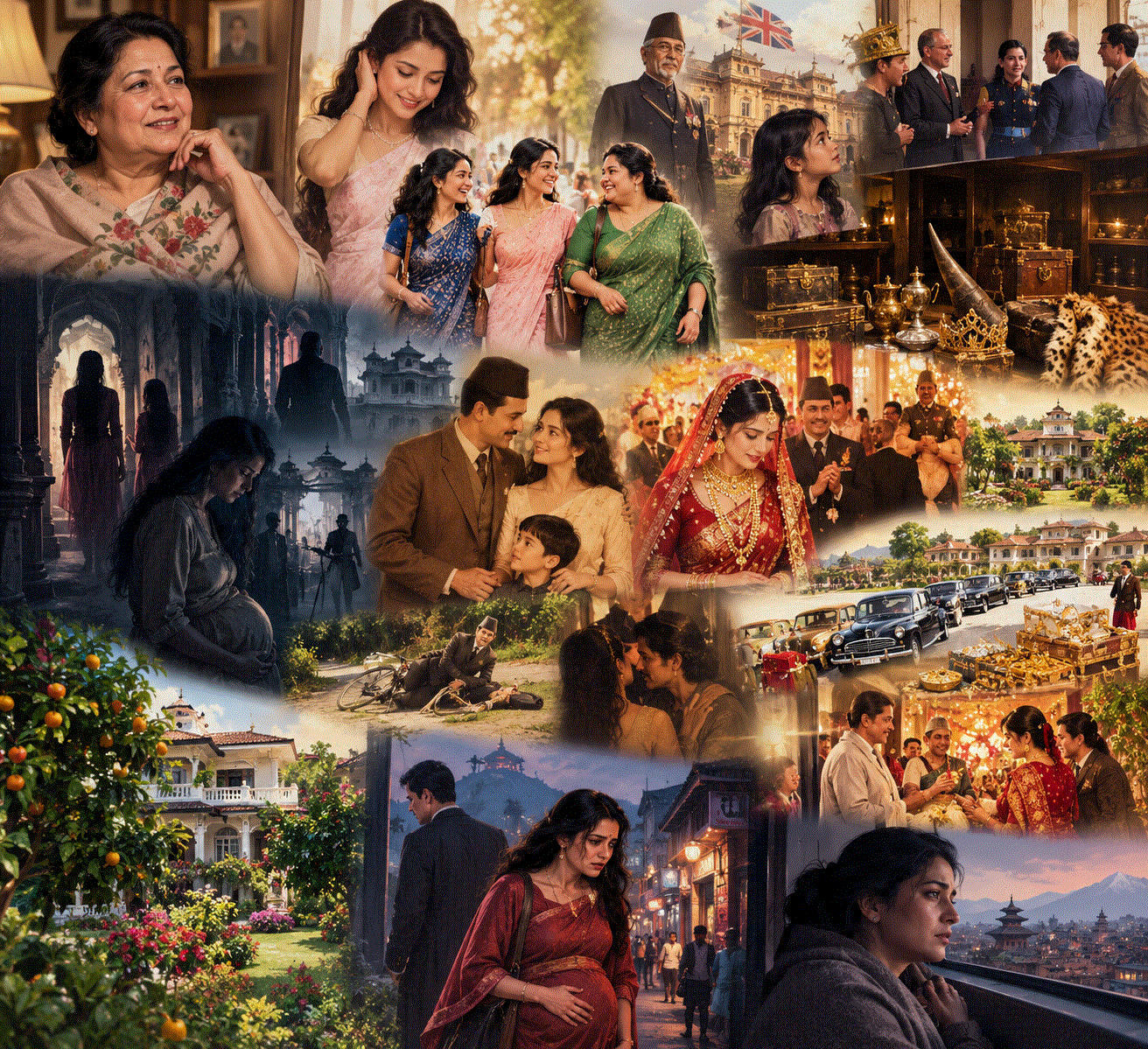
She often remembered her college days with a smile.
She told me how carefully she used to prepare herself before leaving for college.
A neatly draped saree.
A little makeup.
Beautifully arranged hair.
And finally, her high heels.
She would laugh and say that in those days she thought she looked like the prettiest girl in the world.
She had two close friends, both from Marwari families.
The three girls were almost inseparable.
Because Sarita was slender while her friends were rather plump, their friends would tease them:
“Two hajuraamas with their granddaughter!”
Everyone would laugh.
Sarita would pretend to be annoyed, but she enjoyed those carefree days.
Her childhood memories went even further back.
She often spoke proudly about her grandfather and the bravery honour associated, according to her family story, with Queen Victoria.
Her father also frequently met foreign delegates, diplomats, and important visitors. Sometimes Sarita accompanied him.
As a child, she found herself surrounded by unfamiliar faces and elegant conversations.
She may not have understood their importance then, but she remembered them.
Then there were the mysterious storerooms.
Two rooms in their house filled, according to Sarita, with valuable possessions—gold and silver ornaments, rhinoceros horns, animal skins, and other costly objects.
To a child, those rooms must have seemed like secret chambers.
She told me that many of these possessions were eventually presented to His Majesty the King as gifts.i
But the most fascinating stories were not about the treasures.
They were about what happened behind beautiful palace walls.
The Palace Secrets
One day, Sarita Mamu looked at me and said quietly,
“Do you know that a palace can look beautiful and still hide terrible secrets?”
Then she told me stories she had heard about young girls being brought into palace households as maids.
According to those accounts, some were kept in arrangements that went far beyond ordinary domestic service, sometimes becoming unofficial or unmarried wives of members of royal families.
Their lives could be controlled by the people behind those walls.
And then came the darkest part.
Stories of girls who disappeared.
According to the accounts Sarita had heard, if a girl became pregnant or tried to escape, she could face terrible consequences.
Some were said to have been killed.
Some were said to have been secretly buried within palace grounds.
No public mourning.
No explanation.
Sometimes, not even a name.
The palace would simply continue standing—beautiful, magnificent, and silent.
I could never know how much of these stories was documented history and how much belonged to family memory and oral tradition.
But the stories stayed with me.
They made me wonder how many secrets can disappear behind beautiful walls.
Then Sarita told me that her own family story had somehow touched those customs.
Her father, she said, had once been pressured to keep a young girl as a maid, in an arrangement almost like having an unmarried wife.
But their relationship changed.
They became close.
They became friends.
Eventually, he fell deeply in love with her.
He married her and gave her gold coins.
Together, they had a son.
Sarita remembered how deeply attached he was to her.
He wanted her beside him when making important decisions.
Even when he travelled, he missed her.
For a time, he did not want to marry anyone else.
But eventually, family pressure led him into another marriage.
Still, his attachment to the first woman remained part of the family story.
Sarita told me that he would sometimes ride his bicycle simply to visit her.
On one such journey, he fell from the bicycle and broke his leg.
It was a small incident, but somehow it survived in the family memory.
Perhaps because stories are not always preserved because they are grand.
Sometimes they survive because they contain love.
The Marriage That Looked Like a Fairytale
As Sarita Mamu grew older, her parents began to worry about her marriage. They started looking for a suitable match, hoping to find a family worthy of their daughter.
One day, Sarita Mamu told them that a marriage proposal had come from a wealthy, influential, and highly reputed family. The proposal was from an Indian businessman connected with Modi Enterprises.
When her family friends and close relatives heard about the proposal, they became concerned.
“Do not send her to marry a man from another country whom you barely know,” they warned her parents. “You do not know what kind of life she may have there. Her whole life could be ruined.”
Her parents listened carefully. Yet, after much thought, they finally agreed to the marriage of Sarita Mamu with Prakash Modi, whom she identified as the son of K. K. Modi and Kokila Modi.
I remember seeing a photograph of Prakash Modi myself. I also remember seeing some utensils in Sarita Mamu’s house bearing the names K. K. Modi and Kokila Modi. Those little things always made her story feel more real to me.
According to Sarita Mamu, her wedding was nothing short of extraordinary.
She used to say that King Mahendra himself attended her wedding. Four enormous tents were erected for the celebration, and guests were served an astonishing variety of food. She remembered herself dressed and adorned like a queen, surrounded by the grandeur of one of the biggest weddings of that era.
Her parents, she said, sent her to her husband’s home with five cars loaded with gold, silver, valuables, and cash.
When she arrived at the Modi household, she was welcomed with great celebration and ceremony. She often spoke fondly of her father-in-law and mother-in-law, saying that they were extremely happy to have her as their daughter-in-law and considered themselves fortunate to have her in the family.
Her new home seemed like a dream.
There was a vast garden filled with fruit trees and beautiful flowers. Everything around her appeared luxurious, peaceful, and full of promise.
For a while, Sarita Mamu seemed to be living the life of a queen.
But fairytales do not always remain beautiful.
Behind the grandeur of the household was a secret that would soon shatter her happiness.
She said that Prakash Modi was involved with other women.
And within only three months of her marriage, Sarita Mamu had returned to Kathmandu—to Thamel.
But she did not return alone.
She was pregnant.
From that moment onward, she said, the beautiful life she had imagined began to turn into something entirely different.
The wedding had looked like the beginning of a fairytale.
In reality, it was the beginning of the darkest chapter of her life.
And that is where the real story begins…
Author:SURAVI
Stay up to date with our latest news and products! Subscribe to our newsletter to receive the latest articles, important updates, and exciting announcements directly in your inbox.