




For Nepal, the next century is a race to prove that traditional wisdom and modern science can turn a vertical crisis into a blueprint for global mountain survival.
Nepal is a land of sensory whiplash. In the tropical Terai plains, the mercury can climb to a sweltering 39°C by June, only to plummet to a bone-chilling -3°C in the high Himalayas by January. This vertical world, stretching from the Indo-Gangetic basin to the roof of the world, is now the site of a profound environmental drama. Despite contributing a negligible fraction of global greenhouse gas emissions, Nepal stands as one of the most climate-vulnerable nations on Earth, forced to navigate a future it did not choose.
As the country transitions from a decade of internal conflict toward a vision of sustainable development, it faces a unique atmospheric crisis. The challenge is no longer just a matter of shifting seasons; it is about managing a reality where the traditional cycles of water and weather are being rewritten. How does a nation prepare for a future that is simultaneously warming, flooding, and gasping for air?
To understand Nepal’s trajectory is to confront a series of paradoxes. From the melting “Water Towers” of the north to the smog-choked plains of the south, the country has become a global sentinel—a “canary in the coal mine” for the planetary shifts of the 21st century.
The Elevation Paradox: Why the Peaks are Heating Faster
In the high Himalayas, warming is not a distant projection; it is an accelerated reality. Scientific records from 1976 to 2015 reveal a phenomenon known as “elevation-dependent warming.” While the entire region is heating, higher altitudes are experiencing more pronounced increases, specifically a rate of +0.045°C per year for maximum temperatures.
The fate of these mountain communities hangs on global carbon trajectories. Under a “business as usual” high-emissions scenario, Nepal’s mean annual temperature is projected to soar by 6°C by the year 2100. Conversely, rapid global emission reductions could limit this rise to 1.6°C.
“In Nepal, under a high emissions scenario, mean annual temperature is projected to rise by about 6°C on average from 1990 to 2100. If global emissions decrease rapidly, the temperature rise is limited to about 1.6°C.” — Climate and Health Country Profile
This amplification turns the Himalayas into a global indicator of fragility. As the mountains heat up, they lose their ability to act as stable environments for the life that depends on them, signaling a crisis that will eventually flow downstream to the rest of the world.
The Smog-Chilled Terai: A Counter-Intuitive Threat
While the peaks face a “burning” trend, the tropical Terai plains are grappling with the “Cold Wave”—a paradox where localized human activity creates deadly cooling in a warming world. A cold wave in Nepal is defined by a rapid 10–15°C drop in temperature, characterized by a stagnant, thick blanket of “smog” that stretches across 1,500 square kilometers.
This is not a natural weather event. This toxic shroud is fueled by human activities: the burning of solid fuels, industrial brick kilns, and crop stubble. Between 2001 and 2010, these events affected nearly 1,800 people and were associated with 376 deaths across 23 Terai districts. It is a grim irony that while the globe warms, localized pollution is trapping the most vulnerable citizens in a man-made micro-climate of extreme, lethal cold.
The Killer in the Kitchen: Household Air Pollution
The most immediate environmental threat to Nepalese lives is found not in the vast atmosphere, but within the home. Approximately 80% of the national population relies on solid fuels like wood and dung for cooking—a figure that reaches 91% in rural areas. This reliance has birthed a domestic health crisis of staggering proportions.
Roughly 54,900 annual deaths in Nepal—accounting for 42% of the country’s total mortality—are attributable to household air pollution. In this context, the transition to “electric cooking” is not merely a climate target; it is a critical life-saving medical intervention.
Diseases Exacerbated by Household Air Pollution:
- Ischaemic heart disease
- Stroke
- Lung cancer
- Chronic obstructive pulmonary disease (COPD)
- Acute lower respiratory infections (particularly in children under five)
The Upward March: Nature on the Move
As their climate niches vanish, Nepal’s ecosystems are quite literally climbing the mountains. This vertical migration is a desperate survival tactic. The treeline for Abies spectabilis (Himalayan Silver Fir) has been advancing upward at a rate of 2.61 meters per year, while the permanent snowline in the Everest region has shifted 182 meters higher over the last five decades.
This shift threatens “Humboldt’s Enigma”—the scientific observation that mountains host a disproportionate concentration of the world’s biodiversity, including half of the planet’s hotspots, despite their small land area. As species move up, they face an “upward squeeze,” running out of room to migrate. This invites an invasion of lower-altitude species like the weed Mikania micrantha and the toxic Parthenium hysterophorus, which could thrive at high altitudes with just a 3°C temperature rise, degrading the specialized habitats of endemic icons like the Snow Leopard and Red Panda.
“Nepal’s mountainous regions serve as both indicators of global climate change and critical refugia requiring immediate conservation attention to maintain ecological integrity.” — Climatic Trends and Their Impacts on High-Altitude Ecosystems in Nepal
The Glacial Countdown and the Water Tower Crisis
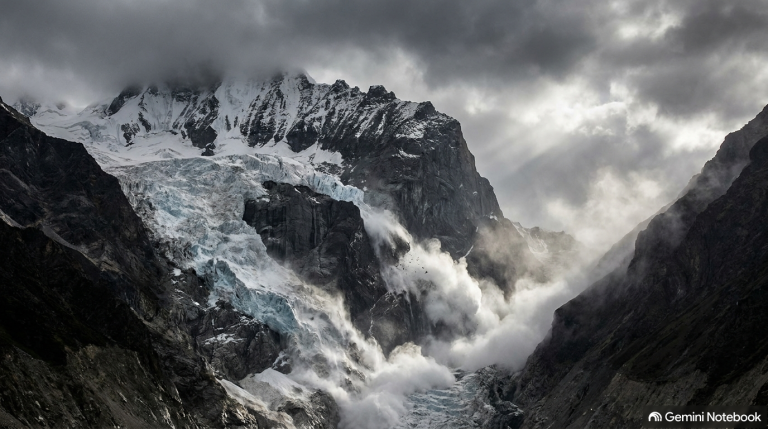
The Himalayas are the “Water Towers” of Asia, but the reservoirs are leaking. Over the past fifty years, the Nepal Himalaya has lost 15% of its total glacier surface area. In the Mount Everest region alone, glaciers have shortened by 6.1 meters per year since 1962.
This retreat creates new, catastrophic hazards. Meltwater is pooling into rapidly expanding glacial lakes, such as Lower-Barun, which has grown aggressively since its formation in the 1970s. This increases the risk of Glacial Lake Outburst Floods (GLOFs) for those living below. For downstream residents, the melting of “upstream reserves” translates into dry springs and depleted aquifers, making the physical and economic cost of water collection a rising burden for families.
Conclusion: Resilience as the New Century’s Mandate
Nepal’s path forward is defined by five strategic pillars of resilience:
- Climate-Resilient Healthcare: Upgrading infrastructure and integrating early-warning data into disease surveillance.
- Decarbonization: Phasing out solid fuels in favor of electric cooking to save tens of thousands of lives annually.
- Water Management: Restoring wetlands and managing aquifers vulnerable to climate-induced recharge drops.
- Traditional Ecological Knowledge (TEK): Empowering local communities to pair indigenous wisdom with modern science to manage ecosystems.
- Building Codes: Enforcing stringent standards to mitigate the immense seismic hazard along the Himalayan arc, particularly in high-risk central and eastern zones.
The integration of TEK with modern climate science offers a unique blueprint. By combining centuries-old weather-prediction wisdom with satellite data on glacial retreat, Nepal can build a defense that is both high-tech and deeply rooted in the land.
For Nepal, the next century is a race to prove that traditional wisdom and modern science can turn a vertical crisis into a blueprint for global mountain survival.
Stay up to date with our latest news and products! Subscribe to our newsletter to receive the latest articles, important updates, and exciting announcements directly in your inbox.